· Skinlazia team · Guides · 9 min read
Fungal Acne on Brown Skin: Dark Spots Explained
Fungal acne on brown skin often arrives as skin-colored bumps and lingering dark marks. See why it hides so well and how to audit your products.
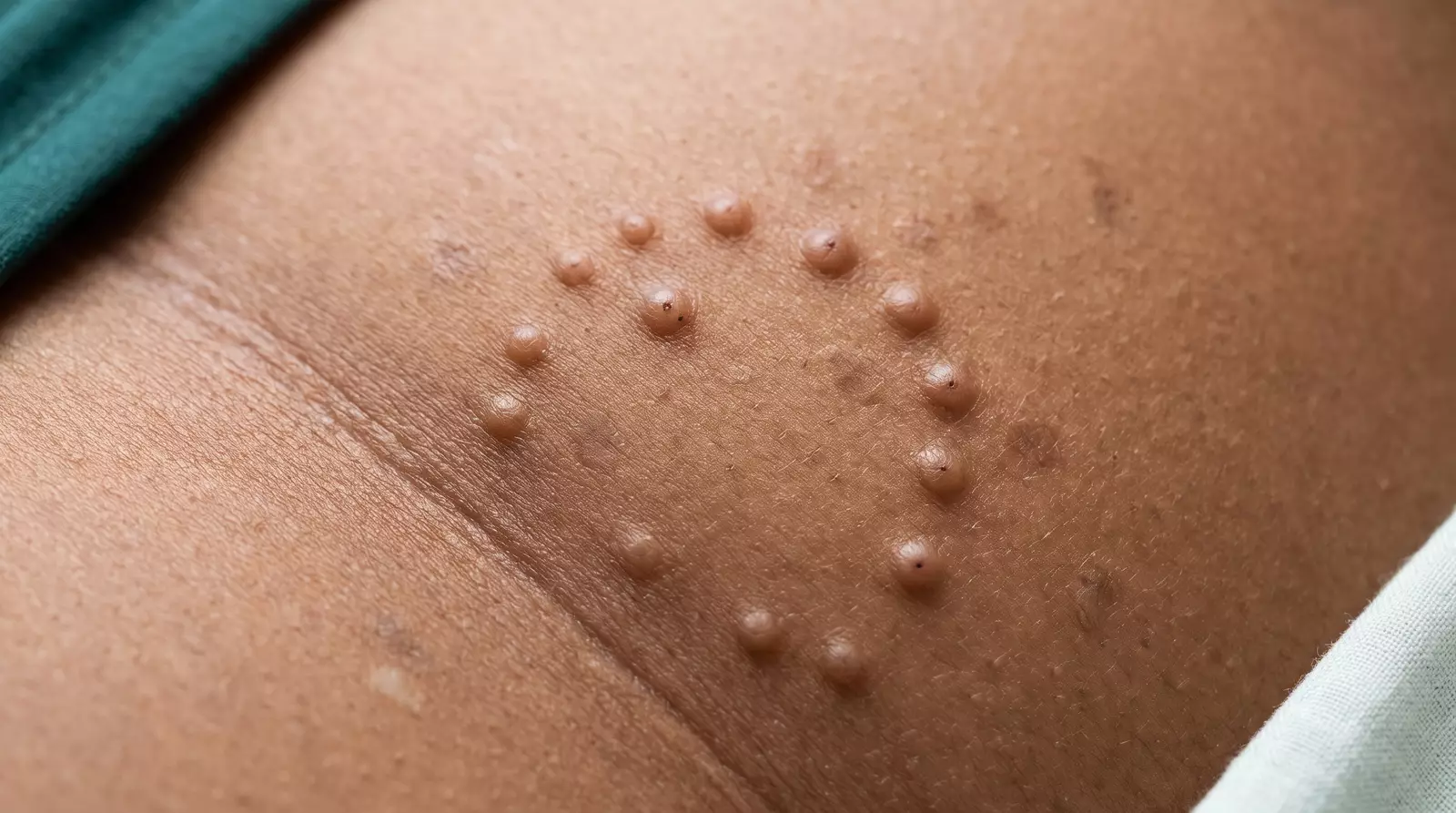
Fungal acne on brown skin can be easy to miss, because the bumps often arrive in your own skin tone instead of a bright red, and the marks they leave can outlast the bumps themselves. The condition behind the nickname is Malassezia folliculitis, a yeast overgrowth inside the hair follicle rather than a bacterial breakout (Chalupczak & Lipner 2025). Deeper skin tones add a second layer to the story, since the same inflammation that produces the bumps can also leave darker patches behind. A dermatologist owns the diagnosis, while the product side is something you can examine on your own shelf today.
See our medical disclaimer for details.
What does fungal acne look like on brown skin?
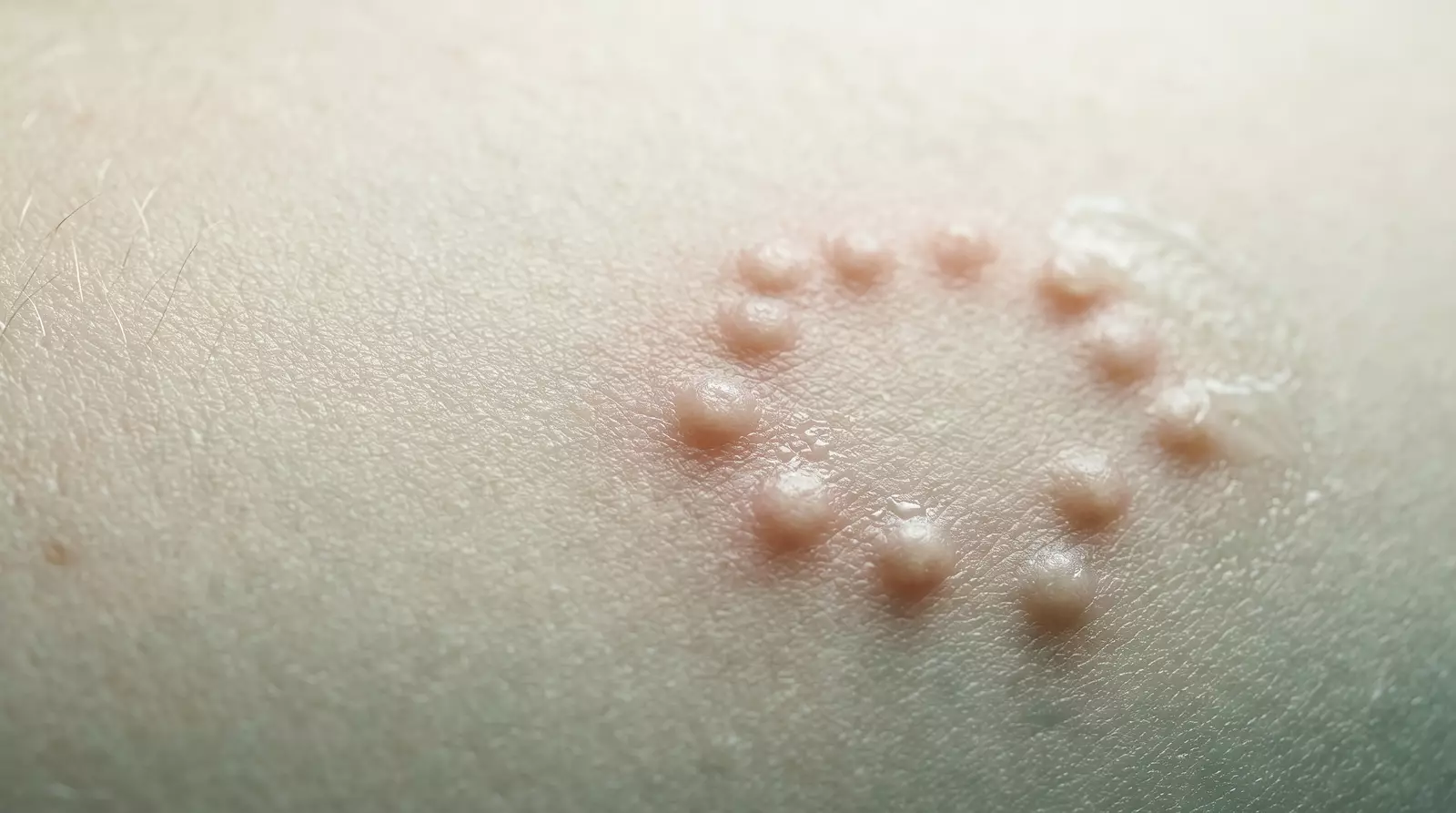
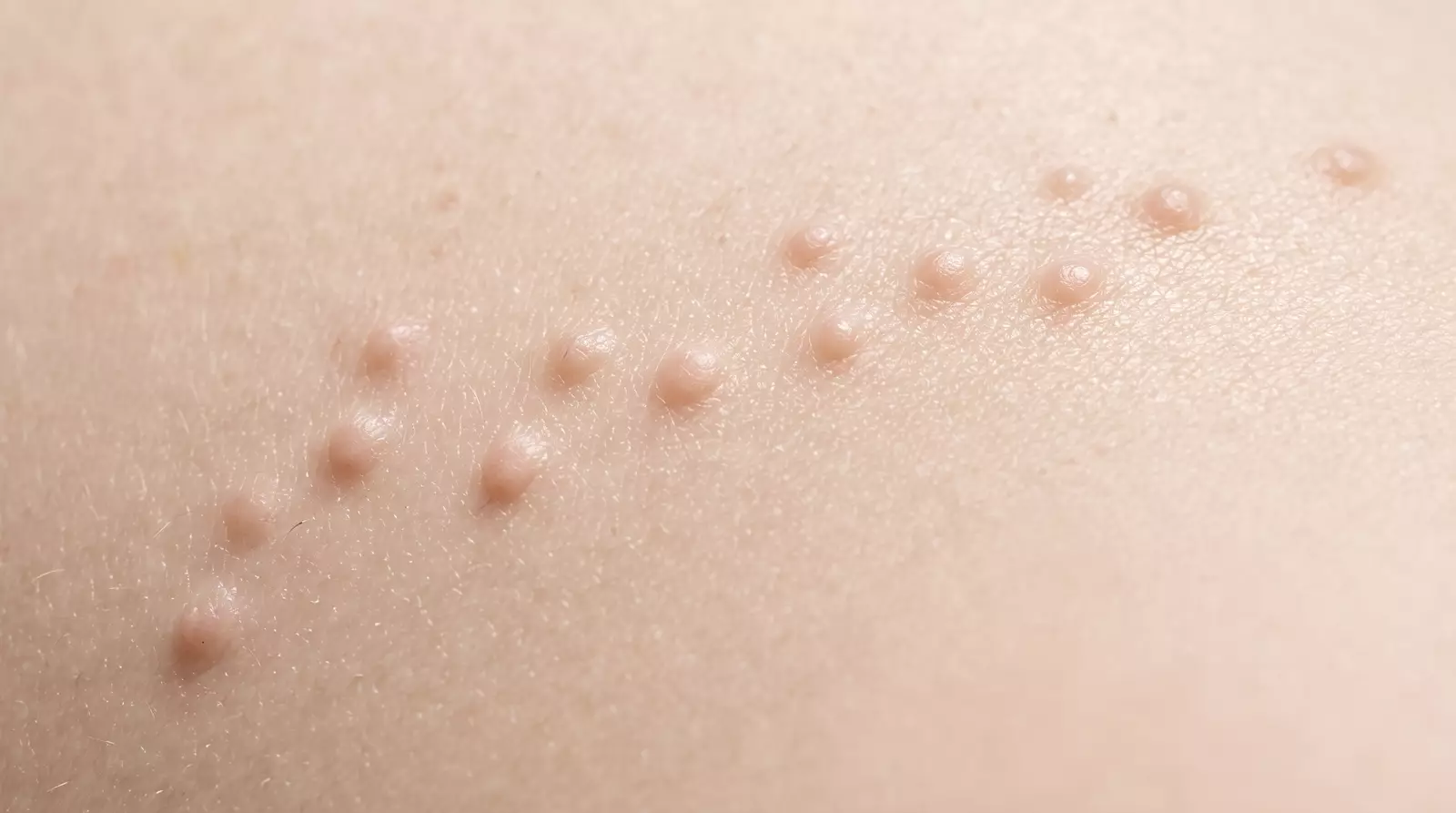
On brown skin, fungal acne shows up as a cluster of small, look-alike bumps that sit close to your natural colour, so the first clue is often texture rather than redness. The 2025 review describes the lesions as one to two millimetre papules and pustules centred on the follicle, either red or skin-coloured, scattered across the oily zones such as the upper chest, back, shoulders and face (Chalupczak & Lipner 2025). A cluster that stays quiet in tone can hide inside freckles, old marks or natural unevenness for a long time before anyone thinks to question it.
What separates the eruption from a standard breakout is the sameness of it, because the bumps tend to match each other in size and shape instead of offering the usual mix of blackheads, whiteheads and deeper spots. The review calls the absence of comedones, nodules and cysts a hallmark feature, and that absence is often the detail that makes a clinician look twice (Chalupczak & Lipner 2025). Itch is another common thread, with 65% of patients in a series of 110 confirmed cases reporting it (Prindaville et al. 2018). An itchy, uniform cluster on the upper body is a far more useful signal than colour alone.
The distribution follows the oil, and in the lesion-distribution work summarised by the same review, the face was involved in 57% of patients, the back in 53%, the extensor arms in 38.8%, the chest in 36.7% and the neck in 18.3% (Chalupczak & Lipner 2025). That pattern matters on brown skin because a fresh crop of bumps can land on top of marks from a previous flare and make the whole area look more irritated than it is.
Why does fungal acne leave dark marks on brown skin?
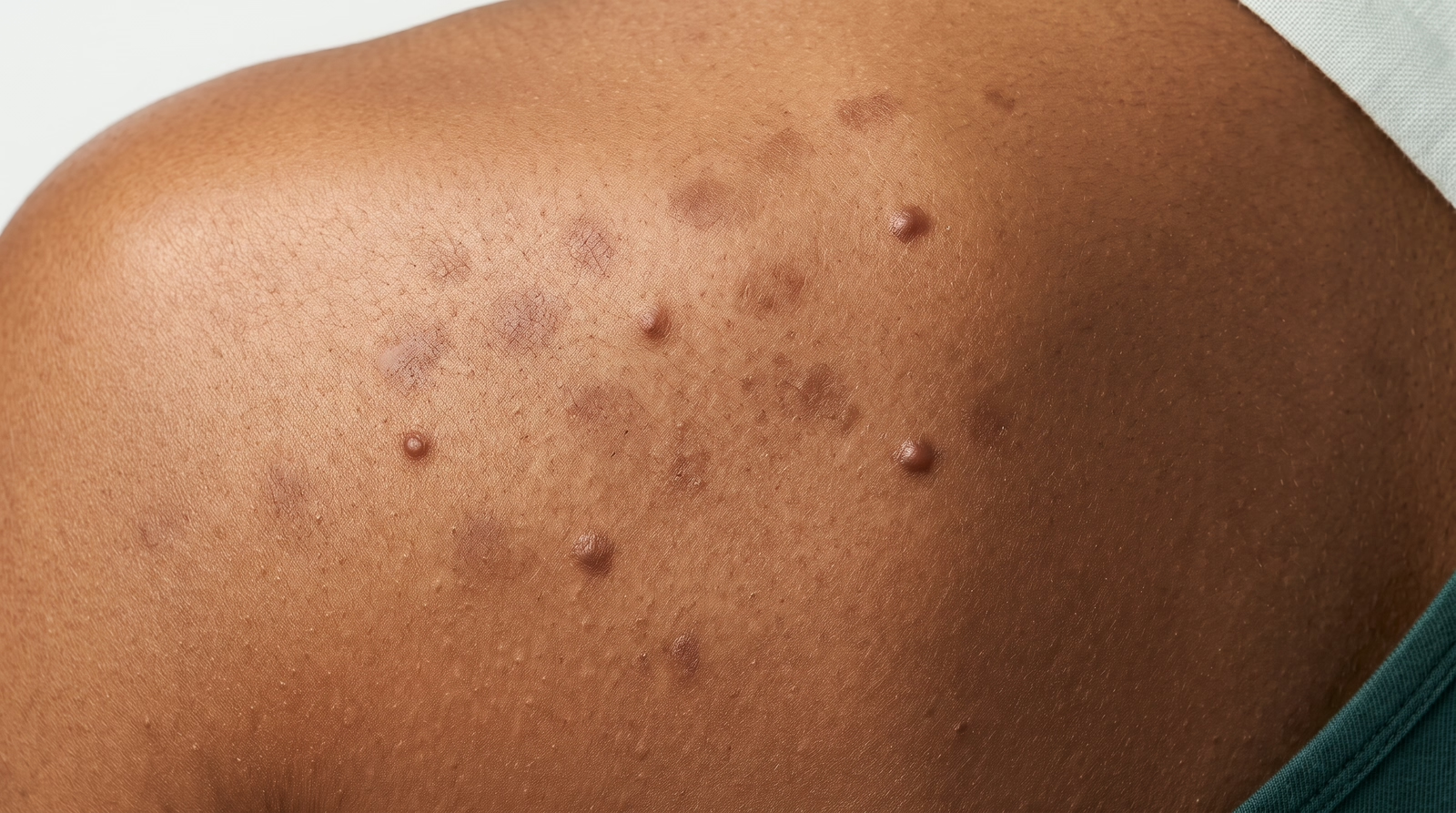
The marks are part of how the eruption behaves rather than a separate condition, and the 2025 review notes that hyperpigmentation is common and that resolving lesions can leave a residual brownish discoloration (Chalupczak & Lipner 2025). That single line explains a lot of the frustration people describe, because the bumps can flatten while the colour stays behind and keeps the skin looking active.
Excoriations appear in the same list of common findings, which is one more reason to keep your hands off an itchy cluster (Chalupczak & Lipner 2025). Picking does not remove the lesion, and the skin around it has already been through an inflammatory event that it now has to settle. On brown skin that settling phase is often the part that gets noticed most, since the leftover colour can be more visible than the original bump ever was.
The review frames that discoloration as part of the resolving phase rather than as a new breakout, and reading an old mark as fresh activity is a common way to end up over-correcting with stronger products. If a patch is flat, brown and quiet, it is telling a different story from a raised, itchy papule, and the two stories call for different responses. Sorting them by feel and texture is more reliable than sorting them by colour alone.
What gets mistaken for fungal acne on deeper skin tones?
Ordinary acne and bacterial folliculitis are the two look-alikes that come up most often, and the review notes that telling them apart can be difficult when itch is absent or when the lesions sit only on the face (Chalupczak & Lipner 2025). Both can produce small bumps in the same oily zones, and both can leave pigment behind on brown skin, which is why a mirror inspection tends to produce more questions than answers.
The history often carries more weight than the photograph. In the 110-case series, 75% of patients had already been through acne care that did not work before the correct picture emerged (Prindaville et al. 2018). Months of ordinary acne products with no change is exactly the kind of detail that belongs in a dermatology conversation, and it is far more useful than a description of the bumps alone.
A dermatologist can use dermoscopy, a skin scraping examined under a microscope, or the response to antifungal therapy to work out what is going on (Chalupczak & Lipner 2025). That work is clinical, and no ingredient list can replace it. What a list can do is remove one variable from the equation while you wait for an appointment, which is a modest but real contribution.
Which products should you check first?
Start with the leave-on products, because a moisturizer or serum stays in contact with your skin far longer than a rinse-off cleanser. Malassezia is a lipid-dependent yeast, described in the review as lipophilic, which is why the fats in a formula matter more than how light or heavy it feels (Chalupczak & Lipner 2025). A richer cream can be gentler than a light gel, and the front label won’t tell you which is which.
The ingredient list is the only part of the package that carries evidence, so that is where the audit should start. A few habits make the process faster:
- Pull the full ingredient list from the packaging or the brand’s own site, never from the marketing copy.
- Check the leave-on products first, since they stay in contact with your skin the longest.
- Score each exact name with the ingredient checker so the verdict comes from the dataset instead of a guess.
- Change one product at a time and keep the rest of your routine steady for a few weeks.
Scoring names beats sorting brands into good and bad, because the same company can sell a formula that feeds the yeast and one that doesn’t. The full list of ingredients to avoid for fungal acne walks through the flagged side, and what fungal acne safe actually means explains the community label in plain terms. The methodology page shows how each name earns its verdict, which is worth reading once so the results stop feeling arbitrary.
A short routine is easier to judge than a shelf full of new bottles, and the moisturizers with no known triggers are screened against the same dataset. Keep the swap list small, give each change enough time to show a pattern, and resist the urge to rebuild everything in one weekend. The goal is a routine you can read clearly, not a perfect shelf.
Will a fungal acne safe routine fade the dark marks?
A routine built on products with no known triggers can reduce the chance of new bumps, but it won’t erase a mark that has already formed. Fading existing pigment is a separate question from calming the follicles, and a dermatologist is the right person to advise on it. The honest expectation is that removing the yeast’s fuel helps the next few weeks behave better, while the older marks follow their own slower timeline.
You can skip the urge to scrub or pick at an itchy cluster, since irritation is the last thing a pigmentation-prone patch needs. You can also skip the idea that a stronger acid is the answer just because the bumps have not budged, because the yeast is not a bacterium and the usual acne logic doesn’t map onto it cleanly. A gentler routine that you can actually follow for a month beats an aggressive one that leaves the skin angry after a week.
The label fungal acne safe is a marketing shortcut, and the ingredient list is the part that carries evidence. A product can wear the phrase and still deserve a careful read, which is why the checker exists. If a formula passes the dataset cleanly and your skin tolerates it, that is a reasonable place to stop shopping and start observing.
When should you see a dermatologist?
See a dermatologist if the bumps are painful, keep spreading, leave new marks, or stay unchanged after several weeks of a gentler routine. A dermatologist can confirm what the eruption is and may prescribe antifungal treatment when Malassezia is the cause (Henning et al. 2023). That appointment is also the right place to ask about existing dark marks, because the advice for settled pigment differs from the advice for active bumps.
People with a weakened immune system run a higher risk of the condition, and that group deserves a lower threshold for booking (Green et al. 2023). Recurrent flares after a quiet stretch are another reason to check in rather than restart the same experiment. A clinician can see the pattern across visits, while a single shelf audit only sees one moment.
What should you take away?
Fungal acne on brown skin is a texture problem first and a colour problem second, and both parts deserve their own attention. The bumps respond to the environment you give them, which is where a careful product audit helps, while the marks left behind follow a slower path that a dermatologist can guide. Sorting one leave-on product at a time, scoring exact names, and keeping your hands off an itchy cluster is a realistic plan for the next few weeks.
If the bumps are painful, spreading or leaving fresh marks, book the appointment rather than buying another bottle. If you’re still deciding whether the bumps are worth a closer look, the guide to small bumps on the face that aren’t acne walks through the look-alikes. The checker and the app are there for the label question, and the medical question belongs with a clinician who can see your skin.
Quick answers
Does fungal acne look different on brown skin?
It often does. The bumps can be skin-coloured rather than red, so they read as texture and can blend into natural unevenness. Itch and the uniform size of the bumps are more reliable clues than colour.
Does fungal acne leave dark spots on brown skin?
It can. The 2025 review notes that hyperpigmentation is common and that resolving lesions can leave a residual brownish discoloration, which often outlasts the bumps themselves.
Is fungal acne the same as regular acne?
No. It is Malassezia folliculitis, a yeast overgrowth inside the hair follicle, while ordinary acne involves clogged pores and bacteria. The absence of comedones, nodules and cysts is a hallmark of the follicular condition.
Which products should I check first for fungal acne?
Start with the leave-on products, since they stay in contact with your skin longest. Read the full ingredient list, score the exact names with the checker, and change one product at a time so you can see what helped.
Should I use strong exfoliating acids on fungal acne?
A gentler routine is a better first step, because irritation adds inflammation to skin that is already pigment-prone. A dermatologist can advise on actives once the picture is clearer.
When should I see a dermatologist about fungal acne on brown skin?
Book an appointment if the bumps are painful, keep spreading, leave new marks, or stay unchanged after several weeks of a gentler routine. A dermatologist can confirm the cause and may prescribe antifungal treatment.